
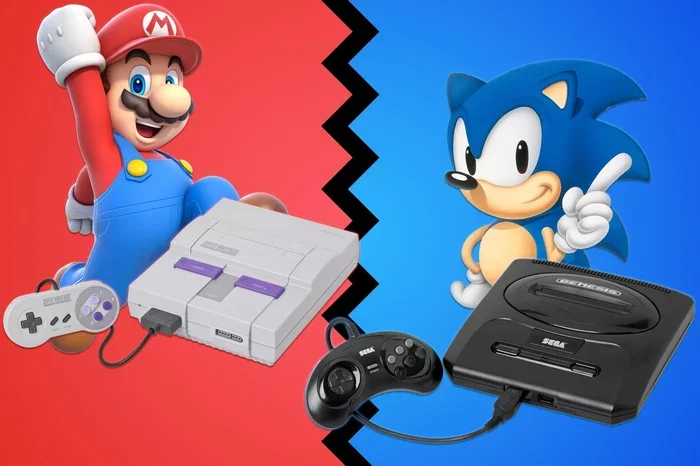
Featured image for Nintendo vs Sega consoles
Image source: tamatem.co
Nintendo’s longest‑running rival is Sega, but Sony and Microsoft have each reshaped the competition. This guide breaks down every major showdown, the numbers behind them, and why the rivalry still matters for players today.
When you think of video‑game history, Nintendo is usually the first name that comes to mind. But the company never ruled alone. From the moment the Nintendo Entertainment System hit living rooms in 1985, a series of fierce competitors stepped up, each trying to steal a slice of the market. This article walks you through every major nintendo rival, explains why they mattered, and shows how the competition shaped the games you play today.
We’ll answer the classic journalistic questions: who challenged Nintendo, what hardware and strategies they used, where the battles played out, when each showdown peaked, and why the rivalry still influences modern gaming. Think of it like a sports league — each season brings a new contender, new rules, and new records.
Key Takeaways
- Sega defined the 16‑bit era: The Genesis/Mega Drive sold over 30 million units, directly challenging the SNES.
- Sony’s PlayStation changed the market: The original PlayStation moved 102 million units, making disc‑based gaming mainstream.
- Microsoft entered with services: Xbox Live launched in 2002, turning online play into a core console feature.
- Handheld battles mattered: Game Boy’s 118 million sales dwarfed rivals like the Game Gear and PSP.
- Indie and mobile games are the new front: Platforms like the App Store and Steam now compete for the same player time.
- Rivalry drives innovation: Each competitor forced Nintendo to improve hardware, software, and online services.
- Understanding the history helps you choose: Knowing each company’s strengths lets you pick the ecosystem that fits your play style.
📑 Table of Contents
The Early Days: Nintendo vs. Sega
Genesis of a rivalry
Sega entered the home console market with the Master System in 1986, but the real clash began in 1989 when the Sega Genesis (Mega Drive outside North America) launched. The Genesis offered a faster processor and a “blast processing” marketing angle that appealed to older kids and teens. By 1992, Sega had captured roughly 55 % of the 16‑bit market in the United States.
Key numbers
- Genesis sales: ~30 million units worldwide.
- SNES sales: ~49 million units worldwide.
- Market share peak: Sega held 65 % of the U.S. 16‑bit market in 1992.
Why it mattered
Sega’s aggressive advertising — “Genesis does what Nintendon’t” — forced Nintendo to speed up its own development cycles. The result? Faster games, better sound chips, and the birth of iconic franchises like Sonic the Hedgehog, created specifically to rival Mario.
The 32‑Bit Battle: Sony Enters the Arena
PlayStation changes the game
In 1994 Sony released the PlayStation in Japan, followed by a global launch in 1995. Unlike cartridges, the PlayStation used CD‑ROMs, drastically lowering production costs and allowing full‑motion video. Developers flocked to the platform, and the console sold 102 million units — still the best‑selling home console of all time.
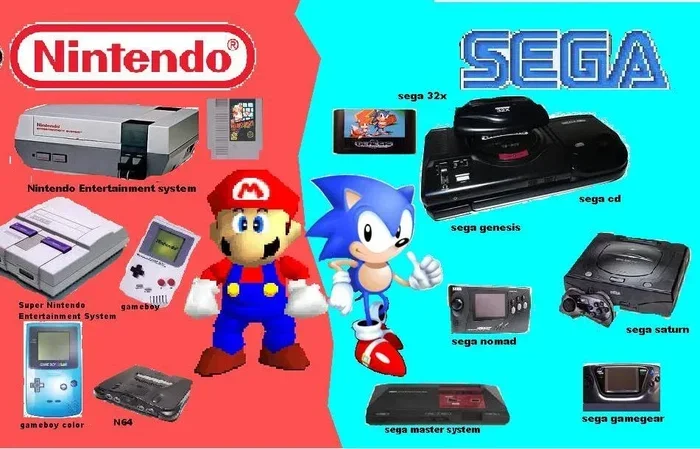
Visual guide about Nintendo vs Sega consoles
Image source: oyster.ignimgs.com
Did you know?
The original PlayStation controller lacked analog sticks. Sony added them in 1997 with the Dual Analog, then refined them into the iconic DualShock, setting the standard for modern gamepads.
Impact on Nintendo
Nintendo responded with the Nintendo 64 in 1996, sticking with cartridges for faster load times. While the N64 delivered classics like Super Mario 64 and The Legend of Zelda: Ocarina of Time, its higher media cost limited third‑party support. The lesson? Media format can dictate a console’s library depth.
The Handheld Wars: Game Boy vs. Competitors
Game Boy dominance
Launched in 1989, the monochrome Game Boy sold 118 million units (including Color and Advance revisions). Its secret weapon? Battery life — up to 30 hours on four AA batteries — and a library anchored by Tetris, a pack‑in title that became a cultural phenomenon.
Challengers that fell short
- Sega Game Gear (1990): Color screen, but only 3‑hour battery life; ~10 million sold.
- Atari Lynx (1989): Advanced graphics, high price; <3 million sold.
- Sony PSP (2004): Strong multimedia features; ~82 million sold, yet never dethroned the Nintendo DS line (154 million combined).
Why handheld rivalry matters
Portable gaming taught the industry that convenience often beats raw power. Nintendo’s focus on low‑power hardware and strong first‑party titles created a moat that even technically superior rivals couldn’t cross.
Modern Era: Microsoft and the Power of Services
Xbox arrives
Microsoft entered the console race in 2001 with the original Xbox. Its flagship feature was Xbox Live, a unified online service that required a broadband connection — a bold bet in the dial‑up era. By 2005, Xbox Live had 2 million subscribers; today it exceeds 100 million.
Service‑first strategy
With the Xbox 360 (2005) and Xbox One (2013), Microsoft doubled down on digital storefronts, backward compatibility, and Game Pass — a Netflix‑style subscription offering hundreds of games for a monthly fee. As of 2024, Game Pass boasts over 30 million subscribers.
Nintendo’s answer
Nintendo launched the Switch in 2017, blending home and portable play. While it lacks a direct Game Pass equivalent, Nintendo Switch Online offers classic libraries and cloud saves. The hybrid concept proved a unique differentiator, selling over 130 million units by early 2025.
Indie and Mobile Challengers: New Frontiers
App Store and Google Play
Smartphones turned every pocket into a gaming device. The App Store (2008) and Google Play (2012) now host millions of titles, many free‑to‑play with microtransactions. In 2023, mobile games generated $92 billion — more than PC and console combined.
Steam and the indie boom
Valve’s Steam platform (2003) democratized PC distribution. Indie hits like Hollow Knight, Celeste, and Hades found massive audiences without a publisher. Nintendo later opened the eShop to indies, but the sheer volume on Steam still dwarfs any console storefront.
Analogy: The arcade vs. the living room
Think of mobile and PC as a massive, always‑open arcade where anyone can set up a cabinet. Consoles are curated living‑room experiences. Both coexist, but the arcade’s low barrier to entry means new rivals appear daily.
What the Rivalry Means for Gamers Today
Choice drives quality
Every time a nintendo rival pushes a new feature — analog sticks, online matchmaking, subscription libraries — Nintendo evaluates and often adopts a refined version. The result? Better controllers, richer online ecosystems, and more diverse game libraries for everyone.
Ecosystem lock‑in vs. freedom
Investing in a platform means buying into its services, controllers, and exclusive titles. Understanding each rival’s strengths lets you decide whether you value portable hybrid play (Switch), a massive subscription library (Xbox Game Pass), or cutting‑edge graphics and VR (PlayStation).
Future outlook
Cloud gaming, AI‑generated content, and cross‑platform play are the next battlegrounds. Companies that adapt fastest — regardless of brand — will set the agenda. Keeping an eye on the competitive landscape ensures you’re never stuck with yesterday’s technology.
In summary, Nintendo’s story is inseparable from the rivals that challenged it. Sega taught speed and attitude, Sony taught disc‑based scale, Microsoft taught services, and mobile taught accessibility. Each clash forced innovation, and that innovation is what makes modern gaming so exciting. Whether you’re a lifelong fan or a newcomer, knowing this history helps you pick the platform that fits your play style — and appreciate the games that much more.